How Public Art Galleries Became Places to Spend an Afternoon
How did the public art gallery become a place for leisure? See how education, access, and visitor amenities shaped today’s flexible cultural visit.
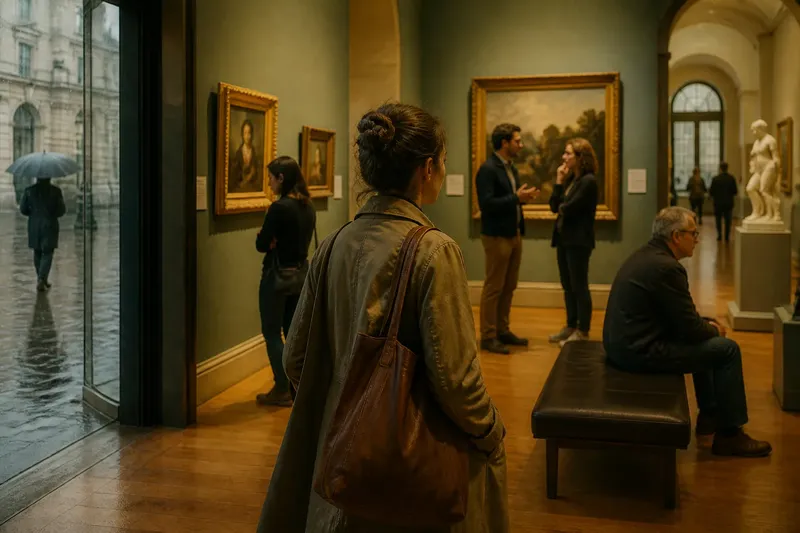
A commuter reaches a public art gallery just as rain begins tapping against the pavement. Inside, one visitor reads a label, another rests on a bench, and a pair quietly debate a painting. The public art gallery now serves as a place to look, learn, meet, or pause—but that everyday role grew from a more formal idea of public access.
What did early public galleries offer visitors?
Public galleries emerged from a change in who could encounter collections that had often been held by monarchs, institutions, or private owners. Opening collections to the public made art available for shared viewing, though access alone did not tell visitors how to approach the rooms or their contents.
In the nineteenth century, institutions such as London’s National Gallery and the Metropolitan Museum of Art in New York developed within distinct civic and educational settings. Their histories are not interchangeable, and neither can stand in for every gallery. Broadly, however, public collections were associated with instruction as well as display: seeing art was treated as a way to cultivate knowledge and judgment.
The formal atmosphere could make a visit feel like an assignment. Visitors encountered carefully arranged works, explanatory labels, and expectations of quiet conduct. Those features gave collections order, but newcomers might still wonder whether they needed art-historical knowledge to belong.
Public access opened the door; interpretation and welcome helped people feel able to cross the threshold.
How did galleries make looking easier to learn?
Galleries developed ways to explain works without relying on a visitor’s prior expertise. Wall labels, catalogues, talks, guided tours, and school programs offered different kinds of context, from identifying materials to discussing a work’s subject or historical setting.
Interpretation can direct attention without dictating a single response. A label might name a pigment or explain who commissioned a portrait; a visitor can then look again and decide what that information changes. The artwork remains the center of the encounter, rather than a quiz whose answer is hidden in the text.
Say you enter a room with a portrait of someone holding a small tool. You first notice the person’s expression, then read a label identifying the tool as part of their trade. Looking back, you may notice how the object helps shape the portrait’s meaning; if it does not, you can keep your original response rather than force a revelation.
Read for a question you actually have, then return your eyes to the work.
When did the gallery visit become leisure?
Education and enjoyment were never mutually exclusive, but the idea of a gallery visit as ordinary leisure became easier to sustain as institutions broadened their public offer. More varied programming, accessible visitor information, places to sit, and spaces for meeting helped make a gallery a destination as well as a collection of objects.
That shift did not erase the gallery’s scholarly purpose. It widened the reasons to go: someone might attend a talk, visit a temporary exhibition, meet a friend, or spend a quiet stretch with a familiar work. A visit could be partial and personal instead of a dutiful tour of every room.
Imagine a commuter with an hour before a train. They check a gallery’s current hours and exhibition information, choose one floor, and sit for a while near a sculpture they want to study. If the room is busy, they switch to a quieter gallery; the observable result is a visit shaped around the time and conditions they actually have, not an attempt to complete the building.
For a nearby public art gallery, the practical question is less “Can I see everything?” than “What kind of visit fits this afternoon?”
What made galleries more welcoming places to spend time?
Welcome depends on practical details that can seem unremarkable until they are missing. Clear signs, readable labels, seating, coat storage, accessible routes, and straightforward information about admission and hours all affect how easily a visitor can use a building.
Social spaces and public programs also changed the feel of a visit. A café, family activity, or group tour can make the institution more approachable, while galleries still need quiet areas for people who want to concentrate. The challenge is not to make every room serve every purpose; it is to give visitors clear ways to choose.
Before setting out, check the gallery’s official visitor information for opening hours, entry arrangements, current displays, and access details. If the information is unclear, contact the venue rather than relying on an old listing.
What questions do visitors ask about a public art gallery?
Can I visit a public art gallery without knowing about art?
Yes. Choose a work that catches your attention, look at its subject and materials, and use the label if a question occurs to you. Prior knowledge can add context, but it is not an entry requirement.
Is it acceptable to visit only one gallery or exhibition?
Yes. A gallery visit does not need to cover an entire collection to be worthwhile. Check the floor plan or ask staff which rooms suit your available time, then leave when you are ready.
Do I need to read every label?
No. Labels are optional explanations, not a record of attendance. Read one when it helps answer a question, and look back at the work to see whether the added context matters to you.
Can a gallery be a good place to meet a friend?
It can, especially if you agree on a meeting point and keep conversation considerate of other visitors. Taking turns choosing a work gives both people a clear starting point without requiring a shared opinion.
How can you choose a visit that suits your day?
A gallery’s history may explain why it combines public access, education, and leisure, but the useful question for a commuter is how those features work in a particular building. Check the visitor information, consider whether you want quiet or company, and choose a room or program that matches that preference.
- Observation: The official site lists opening hours that fit your available window. If the gallery is open throughout that period, then plan a visit; otherwise, choose another day or a venue with suitable hours.
- Observation: Entry information says the exhibition you want to see requires advance booking. If a reservation is available, then book before traveling; otherwise, choose a display that accepts walk-in visitors or postpone.
- Observation: The floor plan shows a room or exhibition that matches your interest. If it is open, then make it your starting point; otherwise, select another listed area or ask staff about current closures.
- Observation: Access information confirms a route and facilities that meet your needs. If the details are clear, then use that route; otherwise, contact the venue to clarify or consider a more suitable location.
- Observation: You want a quiet visit, but the gallery calendar lists a busy event in the room you prefer. If another room is open, then choose it; otherwise, visit at a different time or select another day.
- Observation: A friend wants to meet, and the gallery’s visitor information identifies a clear entrance or meeting place. If both of you can reach it, then agree to meet there; otherwise, choose a nearby public meeting point before entering.
These checks turn a vague plan into a decision about hours, access, interests, and company. They also leave room for the part that cannot be scheduled: stopping in front of something you had not meant to see.
A public art gallery became a day-out destination not by abandoning its role as a place of learning, but by making room for more kinds of visitors and more ways to spend time. Check the details that matter for your visit, then let one room be enough if that is where the afternoon takes you.