A Book, a Puzzle or a Small Making Project?
Choose a book, puzzle or small making project by the attention and setup your evening allows, so you can begin without turning leisure into another task.
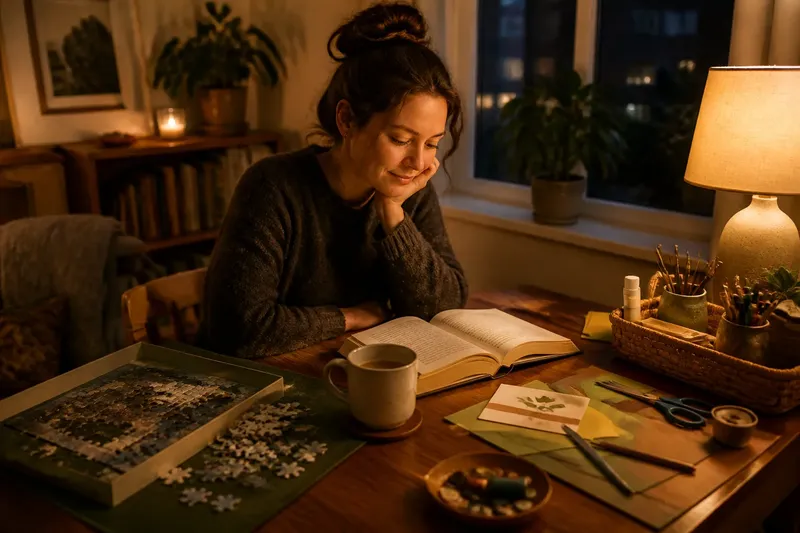
Your commuter bag is on the floor, dinner is finished, and the evening has left you a narrow patch of quiet. Choosing a book, puzzle or small making project is less about finding the best hobby than matching its demands to the attention and space you have tonight.
These pursuits offer different kinds of engagement. A book asks you to follow a line of thought; a puzzle invites you to keep noticing; a making project asks you to turn an idea into something with your hands. Choose in that order: check your energy, check your room, then choose what you want your attention to do.
What kind of attention do you have tonight?
Start by asking whether you can stay with one continuous thread. If you have enough focus to follow a character, argument or sequence of events, reading is often the simplest fit. It needs little space and is easy to pause at a natural stopping point.
If concentration feels patchy, a jigsaw, crossword or other puzzle can give your attention a smaller job: look, try, reconsider. You can step away without losing a complicated train of thought, though a puzzle spread across the table may remain visible after you leave it.
Choose making when you want to do more than absorb or solve. A sketch, a simple paper collage, mending a loose button or shaping a small piece of clay can bring a pleasant sense of activity, but each requires materials and a place to use them.
Pick the activity that suits your current attention, not the person you imagine becoming next month.
How much setup can you tolerate?
Before settling in, consider the full footprint: not only what you will use, but where it will go when you stop. A paperback and a lamp may need only an armchair. A puzzle benefits from a clear, stable surface, while glue, paint or clay may call for a washable cover and a place to keep supplies together.
For a puzzle, choose a size and format that fit the available surface. A small puzzle book is easy to carry and put away; a larger jigsaw works better when a table can remain undisturbed. A roll-up puzzle mat can help reclaim the table, although loose pieces still need a container.
For a small making project, make the materials specific before you begin. “Do something creative” is an attractive plan with no useful instructions. “Use two sheets of colored paper, scissors, a pencil and a glue stick to make a card” has a starting point and a clear place to stop.
Say you have a compact kitchen table, little patience for cleanup and an hour before bed. You could choose a short story, a crossword book or a pencil-and-paper sketch rather than a wet-paint project. The expected result is an evening that starts promptly and leaves the table usable afterward.
What should you gather before beginning?
Once you have chosen, collect only what the activity needs. A small setup lowers the number of decisions between wanting a quiet evening and actually having one.
- For reading: Check that you have a book or e-reader, comfortable light and a bookmark or saved place. If one is missing, choose a text that works with the light and format already available, or gather what you need before sitting down.
- For puzzles: Check that the puzzle, any needed pencil or eraser, and a tray or box for loose pieces are ready. If the surface is clear, begin there; if it is crowded, use a puzzle book or clear a small working area first.
- For making: Check that you have materials for one defined outcome and a protective surface if the work could mark the table. If either is missing, switch to a project using materials on hand or choose reading instead.
- For cleanup: Check whether there is a container or safe place for unfinished work. If there is, set it nearby; if not, choose an activity that can be put away quickly, such as a book or puzzle book.
- For interruptions: Check whether your phone or household tasks are likely to break your focus. If interruptions are likely, choose work that can be resumed easily and mark your place; if not, a longer reading or making session may suit.
- For comfort: Check that your seat, light and drink are within reach. If one is missing, adjust the setup before starting; if the room cannot be made comfortable, choose a lower-effort activity and a better spot.
Keep the supplies within reach, but do not turn preparation into a separate project. If you are still searching drawers long after choosing, simplify the activity.
How do you make each option fit the evening?
Reading: Select a piece that suits the amount of focus available. A chapter in a novel works when you want a continuous narrative; essays, poems or a few pages of nonfiction can suit a more stop-and-start evening. Put the book where you can read comfortably, then begin at the next natural section rather than negotiating with yourself over a daily quota.
Puzzling: Choose one puzzle and decide where unfinished work will live. If you are using a book, keep a pencil beside it and work through a page at your own pace. With a jigsaw, sort pieces only if that feels useful; elaborate sorting systems can consume the evening before the puzzle has had a chance.
Making: Settle on a small result and a material you already know how to handle. For example, fold paper into a simple bookmark, mend a button or draw a row of objects from the kitchen counter. Leave room for an imperfect result; a leisure project does not need to audition for a shop window.
For any option, choose a stopping point before you start. A chapter ending, one puzzle page or the completion of a small object can make it easier to stop without feeling that you have abandoned a grand undertaking.
Which choice fits your situation?
What is best when I am tired?
Reading a familiar, undemanding book or doing a puzzle with clear, small prompts may ask less of you than a project with several materials. Choose the one that feels inviting rather than the one that sounds most virtuous.
What works when I may be interrupted?
A book with a bookmark or a puzzle book is easy to resume after a call or household task. For a larger puzzle or making project, use a tray or container so the work can be moved without scattering its parts.
What if I want to feel productive?
Making can leave a visible object, while puzzling can offer a clear sense of progress and reading can deepen attention without producing anything to display. Decide whether you want an outcome or simply a more absorbing hour; both are legitimate uses of an evening.
Can I switch activities midway?
Yes, if the first choice stops holding your attention. Put its materials away in a way that preserves your place, then change to an option with a different demand, such as moving from a dense book to a short puzzle.
How should you leave the room?
When you are ready to stop, save your place and put away only what needs to be put away. A bookmark preserves a reading spot, a labeled envelope can hold puzzle pieces, and a small box can keep a making project together for another evening.
If you are unsure what to choose next time, notice what made tonight easy or awkward: the reading was too demanding, the table was too crowded, or the materials were already to hand. That observation can guide the next choice without turning leisure into a performance review.
A book, puzzle or small making project works best when its attention and setup match the evening you actually have. Keep one low-friction option ready—a book on the chair, a puzzle book in a drawer or a modest set of drawing materials—and the decision can remain smaller than the activity.